
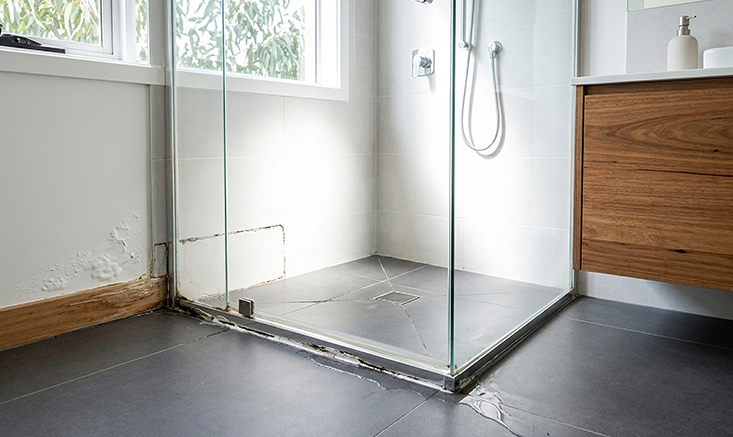
A leaking shower rarely announces itself at the shower. It shows up as a musty smell that won’t clear, paint lifting on the far side of the wall, or a brown ring on the ceiling below. By the time you can see it, the water has already been travelling for a while.
Before you book leaking shower repair in Melbourne, there’s one thing worth knowing: when the water appears. With the shower off, while it’s running, while it drains, or hours afterwards. That timing points to the likely source, and it tells you whether to ring a plumber or a waterproofer first.
This guide covers the signs to take seriously, a short set of checks you can run at home, and what to ask whoever comes out to quote.
Signs your shower is leaking
Water moves through a wall or floor before it surfaces, so the first clue is often in the next room or the room below. Write these down if you notice them:
- A musty smell that comes back after you’ve cleaned and aired the bathroom
- Paint bubbling or peeling on the other side of the shower wall
- Skirting boards or door frames near the shower swelling or staining
- Grout that stays dark long after everyone has finished showering
- Loose or drummy tiles, or silicone that has split, shrunk or gone missing
- A stain on the ceiling directly under the bathroom
One sign on its own doesn’t prove a leak. Steam from long showers in a poorly vented room can also cause mould and peeling paint, so rule that out first with these bathroom ventilation and moisture tips.
Look closely at the corners too. The internal corners and the line where the wall meets the floor are where a bathroom moves, which is why they’re usually finished with a flexible sealant rather than grout. If grout has been run into those corners and is cracking, mention it when you call.
When the water appears tells you who to call
Symptoms point; they don’t prove. Even so, timing is the most useful thing you can give anyone quoting a leaking shower repair in Melbourne, and it takes nothing more than a pencil and a bit of patience to collect.
| When you see the water | What it points to | Who to call first |
|---|---|---|
| Shower off, and it’s still damp or the meter moves | A pipe under pressure, possibly inside the wall | Plumber |
| Shower running, with water outside the screen | Screen seal, door or a silicone joint | Whoever fitted the screen, or a waterproofer |
| Only while water is going down the drain | The floor waste or the join around it | Plumber, then a waterproofer if the join has failed |
| Slowly, hours after showers, worse after long ones | Grout, wall-to-floor joints or the membrane underneath | Waterproofer |
| On the ceiling below | Could be any of the above | Plumber first, and your owners corporation if you’re in an apartment |
For a closer look at each cause on that list, MBBR’s earlier post on shower leak causes and solutions goes through them one at a time.
Five checks to run before you book
Each check rules something out, which makes the next one easier to read. If you can manage without the shower for a day or two, let it dry out first.
- Mark the damp. Pencil around the edge of any stain, or take a dated photo from the same spot. Now you can tell whether it’s growing.
- Read the water meter with everything off. Turn off every tap and water-using appliance, note the meter reading including the red digits, then wait. GWMWater’s guide to checking for leaks with your water meter recommends at least two hours. If the numbers change, there’s a leak somewhere on the property, though not necessarily at the shower.
- Run the shower with the door shut. Watch for water escaping past the screen, the door seals and the bottom corners.
- Aim a hand shower low at the drain. Keep the water off the walls, then check your marks and the room below. Skip this if your shower head is fixed.
- Have a normal shower. Check the marks again later that day and the next morning.
Don’t plug the waste and fill the recess yourself. That pushes more water into a floor that may already be damaged, and a flood test belongs with whoever is diagnosing the leak. Stop using the shower and call someone straight away if water reaches a light fitting or a ceiling starts to sag.
Not sure what your checks showed?
Tell us what you saw and when, and we’ll talk you through what the next step looks like.
Why a slow leak matters
Victoria’s Building and Plumbing Commission describes compliant wet-area waterproofing as crucial to preventing mould, structural damage and water infiltration. A slow leak can feed all three while the tiles on your side of the wall still look fine.
Mould is the part most people notice. The Victorian Government’s Better Health Channel page on mould and your health explains that mould only grows where there’s enough moisture, so controlling it means controlling the source. Scrubbing a patch without stopping the leak won’t hold. The same page notes mould can trigger coughing and wheezing and can worsen asthma and allergies.
Wet areas are also a known weak point in Victorian homes. A Victorian Building Authority study of building insurance claims looked at 2,178 accepted claims and found a water-related defect in 92 per cent of them. Those are insurance claims rather than a sample of every home, so read it as a warning about where defects tend to sit, not as your odds.
What sits under the tiles
Grout and silicone are finishes. The waterproofing membrane sits underneath them, which is why a neat reseal can look like a fix and still not be one.
The Commission’s guidance treats the shower area as the floor within a 1,500 mm radius of the shower rose, with a waterstop at that edge, a floor waste, and a fall towards it. AS 3740, Waterproofing of domestic wet areas, is the Australian Standard most people in the trade will refer to.
That guidance was written against NCC 2022, and Victoria has since moved to NCC 2025. Ask whoever quotes which edition applies to your job rather than treating any figure in an article as the final word, this one included. MBBR’s bathroom waterproofing guide explains how the layers fit together.
Three kinds of repair
Leaking shower repair in Melbourne isn’t one job. What’s needed depends on what your checks found, so be wary of anyone who names a fix before asking when the water appears.
Seals and joints
Screen seals, split silicone and failed wall-to-floor joints are the smallest job. A reseal only holds if the membrane underneath is sound and the damp actually stops afterwards, so re-mark the stain and keep watching it for a few weeks.
Plumbing in the wall or at the waste
A plumber repairs the mixer, pipe or waste connection. You may then have tiles to open up and make good, so ask early who handles that part and whether the waterproofing will be checked while the wall is open.
Strip-out and rebuild
If the membrane has failed, the shower generally comes back to the substrate and is rebuilt in layers: screed and fall, membrane, then tiles. That’s the point where some owners decide to do the whole room at once, and it’s worth knowing what MBBR’s bathroom renovations cover before you choose.
Apartments and rentals
In a house, the problem and the decision are usually both yours. In an apartment, the leak may already be reaching someone else’s ceiling, and pipes or structure may be shared. Speak to your owners corporation before any work starts, and let your neighbour below know too.
Renting? Report the leak to your rental provider in writing rather than organising the repair yourself, and keep your dated photos and meter readings.
What to ask whoever quotes
These questions tell you a lot about how a leak will be handled:
- What do you think is leaking, and how did you test that?
- What happens if you open it up and find something else?
- Will I see the membrane before the tiles go back on?
- Which standard and which NCC edition are you working to?
- Who makes good tiling and plastering afterwards?
It also helps to have your own notes ready: when the water appears, your dated photos, the meter result, whether the bathroom sits over another room, and roughly when the shower was last redone.
Where to find MBBR
MBBR is based at 1 Mallard Close, Williams Landing VIC 3027, and works on bathrooms and wet areas across Melbourne’s inner west. Phone 0411 558 200 or email [email protected].
Act on damp that keeps coming back
If damp keeps returning, or a marked stain is growing, treat it as a leak and book leaking shower repair in Melbourne sooner rather than later. A failed seal is a small job now; the same water left for months can turn it into a strip-out.
Work out when the water appears, run the checks, then call the right trade first. Because MBBR also does waterproofing, tiling and screeding, one conversation can cover the whole shower if a repair turns into a rebuild.
Leaking shower questions
How much does it cost to fix a leaking shower?
The cost of leaking shower repair in Melbourne depends on what’s leaking. A failed seal, a pipe in the wall and a full strip-out are very different jobs, so there’s no honest figure to give here. Get a written quote after someone has tested it and told you what they think the source is.
Can I just regrout or reseal it myself?
You can replace tired silicone, but it only fixes a leak if the silicone was the problem. If water is getting under the tiles, new grout or sealant over it can hide the damp for a while without stopping it. Mark the stain afterwards and watch it.
Can a leaking shower be fixed without removing tiles?
Sometimes. Screen seals and silicone joints are fixed with the tiles in place. If the membrane underneath has failed, ask exactly what a no-removal product repairs and how the result will be tested afterwards.
Is it safe to keep using a leaking shower?
For a small, stable stain, people often keep using the shower while they arrange a quote, keeping showers short and the room well aired. Stop using it if water reaches a light fitting, a ceiling sags, or the stain is clearly spreading.
Will home insurance cover a leaking shower?
That depends entirely on your policy. Read the wording on gradual or ongoing leaks before you assume either way, and ask your insurer before work starts, because they may want to see the damage first. Your dated photos will help.
Talk to MBBR about your leaking shower
Send us what you found and when the water appears, and we’ll talk through your options for leaking shower repair in Melbourne.